Justice Tarot Card Meaning
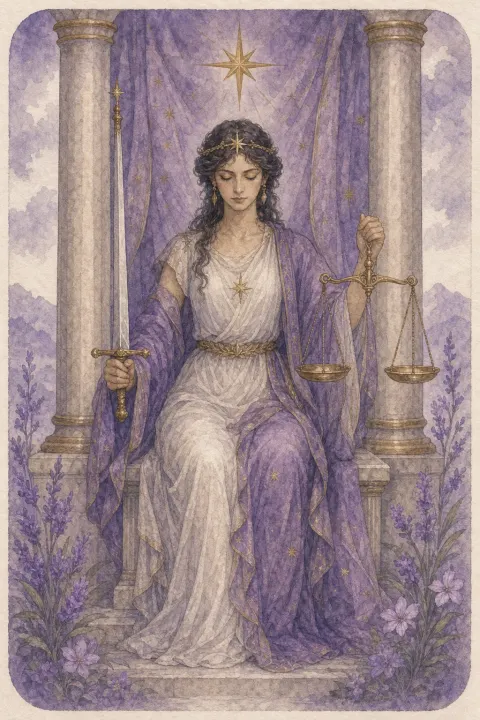
Justice upright. The card of the day you hear both sides and make a fair decision.
Justice reversed. The card of the day you keep quiet in a dispute instead of asking for what is rightfully yours.
Justice is card XI of the Major Arcana and sits right in the middle of the deck. In a reading it tells you to weigh both sides of a decision. The fairness you show in that decision comes back to you later.
- Number
- XI
- Deck
- Major Arcana
- Astrological correspondence
- Libra
- Upright keywords
- balance, fairness, contract, owning the consequences
- Reversed keywords
- unfairness, imbalance, contract trouble, not standing up for yourself
- Yes or no
- Upright yes, reversed no
- Also known as
- Adjustment, in the Thoth deck
Draw Today's card for free in Moon Shine AI, and Selene reads it alongside where the planets are that day.
What do you see on the Justice card?
A woman sits on a throne between two stone pillars. A purple curtain hangs behind her, and a gold star shines on it. In her right hand she holds a sword with the point straight up. In her left hand she holds golden scales with two pans. She wears a thin crown, a white dress and a purple cloak. Her eyes look down toward the ground. Lavender and purple flowers bloom on the steps of the throne.
The scales stand for weighing both sides of a decision. When one pan sinks lower, she sees it and does not hide it. The sword is the clear word that follows the weighing. Once she decides, she does not leave the decision half done, and she does not take it back.
The two pillars are the two parties to an agreement. Her lowered eyes show that she decides by the facts, not by who stands in front of her. Anyone who comes to her gets the same scales. So look at the decision in front of you. Did you hear both sides, or did you check only your own pan?
What does Justice mean upright?
Upright Justice is the day you make a decision after hearing both sides. Two friends fall out, and each one comes to you with their version. Before you say who is right, you let each of them finish.
The card also points to contracts. When a lease or a work agreement lands in front of you, you read it clause by clause. You sign only after you understand every line.
Justice shows that responsibilities have consequences. When you finish a task the way you promised, you get the result you earned. When you break a promise, that result comes back to you too. The card holds the same scales in both cases.
Justice wants you to be as fair with yourself as with others. When you notice a mistake of your own, you admit it without making it bigger, and you fix it. You neither clear yourself completely nor blame yourself more than the mistake deserves.
Picture this. A group of relatives or housemates is deciding who keeps a shared item, and you drew Justice today. Write down what each person wants, then make the decision by looking at that list.
What does Justice reversed mean?
Reversed Justice is the day you let a dispute pass in silence instead of claiming what is yours. Where you work, a task you completed is presented under someone else's name. You hear it in the meeting and say nothing.
The second reversed meaning is imbalance. In a relationship or a business partnership, you carry most of the load. When you ignore this for a long time, resentment builds up inside you.
The third meaning is contract trouble. A clause in a document you signed without reading shows up later. Read the document again from the start, and ask a professional about any part you do not understand.
The reversed card also faces the other way. In an argument, you see only your own side as right and pass judgement without listening. In that case, hold the scales up to yourself too.
Reversed Justice does not blame you. It wants you to state what is yours in a calm voice. This week, put the issue you let slide into writing and send it to the person it concerns.
What does Justice mean in love?
If you are in a relationship, Justice checks whether the load is shared evenly. When chores, spending or making plans always fall to one person, the card makes that visible. Sit down with your partner and talk openly about who handles what.
If you are single, the card describes how you choose, not who you meet. When you meet someone, you judge them by their words and actions, not only by the excitement. You check whether what they said on the first date matches what they do on the second.
Reversed Justice in love shows effort that goes unreturned. You always send the first message, and you always set up the date. The card wants you to correct this, so for a while you leave the first step to the other person.
Justice does not say whether a relationship lasts or ends. It asks you to look at both pans of the relationship; the decision is yours.
What does Justice mean for work and career?
At work, Justice is about getting a fair return for your effort. If you have a review coming up, you list the tasks you took on over the past year and bring that list into the meeting. The card backs that conversation.
If a job offer is on the table, Justice tells you to check the contract details. You do not say yes until working hours, days off and the job description are in writing.
When a dispute breaks out in a team, the card gives you the role of mediator. You hear each side separately, then bring them to the same table. In that meeting, nobody gets cut off mid-sentence.
If Justice comes up while you apply for a job, describe yourself as you are. You do not put work you never did on your résumé, and you do not shrink the work you did.
Reversed Justice at work shows criticism you did not earn or tasks that are split unevenly. Here the card tells you not to stay silent. Write down who did which task, with dates.
What does the Justice card mean for money?
With money, Justice is about who owes what. If you lent a friend money and nobody has mentioned it since, the card tells you to bring it up. You ask calmly when they plan to pay it back.
If you share expenses, the card wants everyone's share to be clear. When you split bills with a housemate, you keep a simple table of who paid what.
If a purchase comes with a right to return, the card tells you to use it. You take the faulty item back to the shop with the receipt and ask for an exchange.
Reversed Justice shows an imbalance with money. A payment of yours runs late, or a fee owed to you arrives short. Find the bank statement and take it to the right office.
Justice weighs your fairness, not your balance. It does not say how much money reaches your account, and it stays out of investment choices. It weighs only how fairly you act in your money decisions.
Is Justice a yes or no card?
Upright Justice says yes, but only for something fair. For questions like signing an agreement or asking for what you are owed, the card tells you to take the step.
Reversed Justice says no. Something in front of you is missing one side, or a clause is unclear. Fill that gap first.
If the answer depends on someone else's decision, the card does not tell you what they decide. If you ask about the outcome of an application, Justice points you to preparing your own file completely. If you ask who wins a dispute, the card takes no side. It shows you only how to say your part clearly and leave the rest at that table.
Justice in a three-card spread
In the app's three-card spread, Justice answers the question of whichever position it lands in. The positions run in this order: Now, What challenges you, Your next step.
Now. A decision sits in front of you, and you already have what both sides said. These days are for weighing it.
What challenges you. An unfairness keeps bothering you, or staying neutral feels hard. You delay your decision so you do not upset anyone.
Your next step. Put your decision in writing. Write your reasons in two sentences and send them to the person concerned.
Justice as advice: what to do today
When Justice is your card of the day, settle one open account today. If you owe a small sum, pay it; if someone owes you, give them a polite reminder. If an argument starts today, wait until the other person finishes speaking. Then state your side in one sentence.
Justice and Libra: the card's astrology link
The Golden Dawn system links Justice to Libra. The scales in the woman's hand and the symbol of the sign are the same object. Libra is ruled by Venus.
In a birth chart, Libra shows relationships, partnerships and how two sides reach agreement. Justice weighs both sides of an agreement too. Sign and card ask the same question: does everyone in this relationship get their share?
Look at which house Libra falls in on your chart to see the area of life where you weigh fairness most. When you open your chart in the app, Moon Shine AI names that house for you.
Why is Justice card number XI?
Justice is number XI in the Rider-Waite deck. In older Marseille decks the same card is number VIII and swaps places with Strength. The Moon Shine AI deck uses XI.
XI is the middle of the 22 Major Arcana cards. The cards before it describe the steps where a person gets to know themselves. With Justice, the focus turns to the balance a person keeps with other people. That is why the card stands in the middle, like the scales of the deck.
In a reading, this position says something plain. You have set up your own routines and started making your own decisions. Now it is time to look at how those decisions affect other people.
Justice vs Judgement: what is the difference?
Both card names suggest a verdict, so people mix them up. The difference lies in what the decision is about. Justice weighs a situation in the present. Two sides stand in front of you, and you hear both and decide fairly. Judgement brings back a matter you put off in the past and asks you to face it.
Think of renting a home. If you are going through the clauses of a new lease with your landlord, you are in Justice. If you finally make the move you have postponed for years, you are in Judgement.
When both cards appear together in a reading, make today's decision fairly first. Then you see that it also closes an old matter that stayed open for a long time.
What does the Justice card mean reversed?
Reversed Justice shows you letting a dispute pass in silence instead of claiming what is yours. It also points to a load that is not shared evenly in a relationship, or to a contract clause you missed.
What does Justice mean in a love reading?
Justice looks at both pans of the relationship. If you are in a relationship, it checks whether effort is shared evenly. If you are single, it tells you to choose someone by their words and actions.
Is Justice a yes or no card?
Upright Justice is a yes, for something that is fair. Reversed Justice is a no; first fill in the missing side or clear up the unclear clause.
Does the Justice card predict a court case?
No. Tarot does not tell you how a court case ends; for that, you speak to a lawyer. Justice shows only how you act in a dispute.
What zodiac sign is the Justice tarot card?
In the Golden Dawn system, Justice matches Libra, the sign ruled by Venus. Both the sign and the card are about balance between two sides and about partnership.