The Emperor Tarot Card Meaning
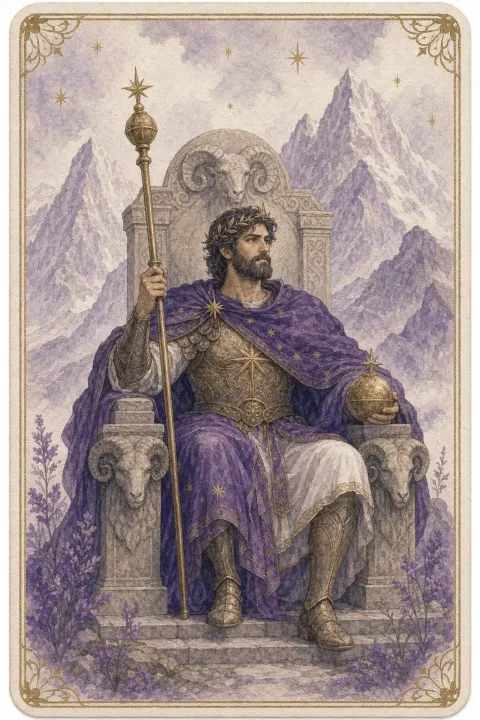
The Emperor upright. The card of the day you are the one who sets the rule and takes on the responsibility.
The Emperor reversed. The card of the day you insist on running everything by your own rules and things get stuck.
The Emperor is card IV of the Major Arcana. He stands beside The Empress as the one who builds order around what she grows. When he turns up in a reading, the matter you asked about needs a decision and a clear limit. You are the one who makes that decision.
- Number
- IV
- Deck
- Major Arcana
- Astrological correspondence
- Aries, zodiac sign
- Upright keywords
- order, setting limits, authority, responsibility
- Reversed keywords
- rigidity, too much control, trouble with authority, dodging responsibility
- Yes or no
- Upright yes, reversed no
- Also known as
- The Emperor; L'Empereur in the Tarot de Marseille
Draw Today's card for free in Moon Shine AI, and Selene reads it alongside where the planets are that day.
What do you see on The Emperor card?
A bearded man sits on a wide throne carved from stone. A ram's head sits at the top of the throne and on each armrest. He wears a laurel wreath and a purple cloak decorated with stars. Under the cloak you see his armor and armored boots. His right hand holds a long scepter with a star at its tip. His left hand holds a golden orb. Sharp, snowy mountains rise behind him.
The ram heads point to the card's sign, Aries, the sign that takes the first step and moves to the front. The armor shows a man who stays ready even inside his own palace. He sits on hard stone, not on a soft chair. The scepter and the orb are the two halves of ruling. The scepter makes the decision, and the orb holds the area that decision covers.
The mountains are bare, with no flower garden anywhere. The picture cares more about solid ground than about beauty. The man looks straight at you, and the question in the image is plain. Who makes the decision here, and if it is not you, why not?
What does The Emperor mean upright?
Upright, The Emperor shows the moment you set the rule and take the responsibility. When the bills at home have been paid in a muddle for months, you sit down one evening. You write each due date on a list and stick the list on the fridge.
The card is about setting limits. If a friend has made a habit of calling you about work at midnight, this time you pick up and answer calmly. You tell them you do not talk about work after nine.
The Emperor also shows the weight of responsibility. When something goes wrong on a task, you do not push the blame onto someone else. You own your part of the mistake and explain how you plan to fix it.
In a reading, this card says the matter you asked about needs structure. It tells you to act from a plan, not from a feeling. A calendar, a list or one clear rule makes this week easier.
Picture a shared home where everyone leaves the dishes for the next person, and the same argument starts every night. With The Emperor in your reading, you call everyone to the table one evening. Together you write down who washes up on which day, and you pin the sheet up in the kitchen.
What does The Emperor reversed mean?
Reversed, The Emperor shows things getting stuck because you want everything run by your rules. If you lead a team, you want to make every call yourself. People stop suggesting anything, and the work piles up on your desk.
The second reversed meaning is rigidity. You make a plan and get angry when it changes. On the first day of a trip it rains, and you still refuse to drop the museum visit on the schedule.
The third is trouble with authority. A rule from a manager or an institution feels unfair to you. Before you start a fight over it, ask for the reason behind the rule.
Another face of the reversed Emperor is dodging responsibility. A decision needs making, and you keep leaving it to someone else. This time the decision is yours.
When the reversed Emperor appears, ask yourself one question. Does this rule really work, or does it stay only because it is a habit? If it is a habit, loosen the rule and check the result a week later.
What does The Emperor mean in love?
If you are in a relationship, The Emperor is about building order and trust together. You and your partner talk through chores, the budget or weekend plans, and you agree on a routine. After that conversation, the small arguments drop off.
If you are single, the card is about knowing what you want. You know in advance which behavior you do not accept. When a date makes a disrespectful remark at the first meeting, you do not go on a second one.
Reversed, The Emperor in love points to control. You want to know every move the other person makes, or they ask about every move you make. The card shows this as something to talk about, not as a punishment. You say plainly where you do not feel safe.
The Emperor in career and work
At work, The Emperor marks a time to take responsibility. Where you work, someone asks you to lead a team, or every decision on a project lands with you. You say yes, and in the first week you hand out everyone's tasks in writing.
The card backs work that runs on rules and structure. Setting up how a business operates, drawing up a budget or writing a contract all belong to this card. In this kind of work you take the steps in order.
If you run your own business, The Emperor tells you to put limits on your hours. You stop answering client messages at seven in the evening. You announce this rule in the first week and then keep it.
Reversed, the card points to a manager who is too strict, or to your own rigidity. When someone on the team brings a suggestion, you hear it out before you answer. Trying part of the idea builds the team's trust in you.
What does The Emperor mean for money?
With money, The Emperor is about building a budget. At the start of the month you write your income and fixed costs into a spreadsheet. By the end of the month you know where each amount went.
The card also shows a payment routine. You set up automatic payments for rent, bills or a loan installment. You stop missing due dates.
Reversed, the card shows money held too tightly or no system at all. If you share a household, you want to approve every purchase alone, and it leads to arguments. You hold a shared budget meeting and make the call together.
The Emperor does not say how large your account grows, and he does not pick an investment for you. His subject is the order of your money: who decides, what the rule is, and whether anyone sticks to it.
Is The Emperor a yes or no card?
Upright, The Emperor is a firm yes. For questions about taking responsibility, setting a rule or stepping up to lead something, the card tells you to accept. A plan stands behind this yes.
Reversed, The Emperor says no. The no comes from trying to push the matter through alone and by force. Call the people you decide with to the table, then ask the question again.
When the outcome rests with someone else, The Emperor does not reveal that person's decision. The card shows you your own ground. Your job there is to tell the person involved what you want, clearly and in good order.
The Emperor in a three-card spread
In a three-card spread, look first at which position The Emperor lands in. The app reads the cards in this order: Now, What challenges you, Your next step.
Now. The responsibility for a task sits with you. You make the decisions, and the people around you expect structure from you.
What challenges you. A rule or a manager weighs on you. Or you wear yourself out trying to control everything.
Your next step. Set a limit. Today you give a kind but clear no to a request you need to turn down.
The Emperor as an advice card
When The Emperor is your card of the day, the advice is order. Take the task that has stayed messy and make a list for it. Write a day next to each item and finish the first one today.
The second piece of advice is about limits. Before you say yes to a request that feels heavy today, check your calendar. If you have no room, say so plainly.
When The Emperor describes a person
When The Emperor stands for a person in a reading, this is someone who carries responsibility and sets rules. A manager, an elder in your life or the person who leads a team shows up as this card. They stand behind their word and know what others expect of them.
When you deal with this person, be clear. If you need something from them, bring your reason and a date with you.
Reversed, the card describes someone who holds the rules tightly and does not want to hear objections. Go to them without raising your voice, with a short proposal in writing.
The Emperor and Aries: the card's astrology
The Golden Dawn tradition links The Emperor to Aries. The ram heads on the throne show this pairing inside the picture as well. Aries is the first sign of the zodiac, and Mars is its ruler. The sign is about stepping forward, making the first decision and taking charge of a task. The Emperor is also the one who decides and takes responsibility.
Look at which house Aries falls in on your birth chart, and you see the area of life where you want to step forward. When you open your chart in Moon Shine AI, Selene names that house for you.
Why is The Emperor number IV?
The Emperor is card IV of the Major Arcana. Four is the number of four corners and of a table with four legs. A four-legged table does not wobble.
The Empress, card III, brings growth. Four draws a frame around that growth. The garden grows, and The Emperor builds a fence around it. In a reading, number IV tells you to set up a structure that protects what you have.
In the old Tarot de Marseille the card is called L'Empereur, and it shows a ruler in profile. The Waite deck shows him from the front, on a throne with ram heads.
The Emperor vs The Hierophant: what is the difference?
The Emperor and The Hierophant get mixed up a lot. Both cards show a bearded man on a throne, and both stand for authority.
The Emperor is the one who sets the rule. He builds the order himself and carries the responsibility for the decision. His question is simple: who decides? The Hierophant is the one who teaches the rule. He passes on a tradition and a tested path that existed before him. His question is different: who knows this work, and what are you learning from them?
If you start at a new workplace, the difference is easy to see. The manager who tells you the hours and the rules on day one is The Emperor. The longtime colleague who sits beside you that same day and shows you the tricks of the job is The Hierophant. When both cards appear together, you learn the rule first and then build your own way of working.
What does The Emperor tarot card represent?
The Emperor represents order, setting limits and taking responsibility. In a reading, he says you are the one who makes the decision. The matter in front of you needs a clear rule.
What does The Emperor reversed mean?
Reversed, The Emperor shows things getting stuck when you insist on running everything by your own rules. It also points to rigidity, too much control or dodging responsibility.
Is The Emperor a good card for love?
Upright, yes; it shows order and trust in a relationship. If you are single, it shows that you know what you want. Reversed, it says control is something you need to talk through openly.
Is The Emperor a yes or no card?
Upright, The Emperor is a yes, especially on questions where you take on responsibility. Reversed, it is a no. Call the people you decide with to the table, then ask again.
What zodiac sign is The Emperor?
In the Golden Dawn system, The Emperor matches Aries. Aries is about taking the first step and moving to the front, and the ram heads on the throne show the link.