The Hierophant Card Meaning
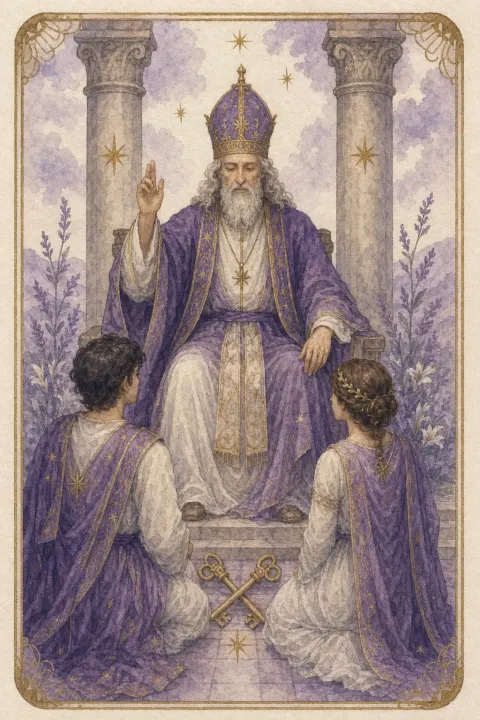
The Hierophant upright. The card of the day you listen to someone experienced and choose a method that has already proven itself.
The Hierophant reversed. The card of the day you skip the way everyone recommends and try something your own way.
The Hierophant is card V of the Major Arcana. He is the one who teaches the order the Emperor built to the next generation. In a reading he tells you that someone has already walked the road you are asking about, and their knowledge helps you.
- Number
- V
- Deck
- Major Arcana
- Astrological correspondence
- Taurus
- Upright keywords
- tradition, teacher, institution, the tried and tested path
- Reversed keywords
- stepping outside the usual mold, questioning the rules, trying your own way, friction with an institution
- Yes or no
- Upright yes, reversed not for now
- Also known as
- The Pope, Le Pape, The High Priest
Draw Today's card for free in Moon Shine AI, and Selene reads it alongside where the planets are that day.
What do you see on the Hierophant card?
An old man with a long white beard sits on a throne between two stone pillars. He wears a tall crown in purple and gold. His right hand is raised, and two of his fingers make a sign. A white stole with gold embroidery hangs down the front of his purple robe.
Two people kneel in front of him with their backs to you. One has short curly hair. The other has braided hair and wears a thin laurel wreath. At the man's feet lie two golden keys, crossed.
The raised hand belongs to a teacher. He passes on what he knows, and the two people in front of him listen. Their kneeling shows the humility of a student: you listen first, and then you learn.
The two pillars mark the door of an institution, such as a school, an association or a professional body. Its rules existed before this man and stay in place after him. The crossed keys are the knowledge that opens that door. That knowledge is not in a book; it sits with the person who teaches it.
Put yourself in the place of the two students. Is there someone who can show you the way on this matter, and are you ready to ask them?
What does the Hierophant mean upright?
The upright Hierophant shows the moment you listen to someone experienced and choose a method that has already worked. You want to learn to bake bread, and ten different recipes online leave you confused. So you walk into the bakery down the street and ask the baker for the measurements they have used for forty years.
The card points to a teacher. This is a time to learn from a class, a master of a craft or an instructor. Instead of working it out alone, you sign up for a course and write down the rules from the first lesson.
The Hierophant also covers institutions. An official application, an exam, a diploma or a membership falls under this card. When you fill in the form, you follow each step by the rules and leave no document missing.
When this card comes up, you do not need to invent a new route for the matter you asked about. Other people have done this before you and mapped the way. Following that map saves you time.
Picture a scene. You have just moved to a new city and you do not know how the paperwork works there. With the Hierophant in your reading, you ask someone who has lived there for years which office to visit first. You finish a full day of errands in an hour.
What does the Hierophant reversed mean?
The reversed Hierophant shows the moment you set aside the path everyone recommends and try a task your own way. Everyone around you wants you to pick a safe career. You decide to take a year off and try a different field.
This reversed meaning is not bad by default. It also tells you that questioning a rule makes sense right now. Where you work, one task has been done the same slow way for years. You suggest a faster method and offer to test it for one week.
The other side of the card is friction with an institution. A rule at a school, a club or a company does not fit you. Before you slam the door, you try the official channel for changing that rule. You write a formal request.
The reversed Hierophant puts one question to you: are you dropping the rule because you know a better way, or only because the rule annoys you? If it is the first, you carry on your own way. If it is the second, you first find out why the rule exists.
What does the Hierophant mean in love?
If you are in a relationship, the Hierophant points to taking it to an official or traditional step. Introducing each other to the people close to you, moving in together or making a commitment are the questions this card raises. The card backs that step and tells you to hear what the people close to you think.
If you are single, the card says you meet someone in a familiar setting. A class, a community group or a mutual friend's home is that setting. The person you meet shares your values.
Reversed, the Hierophant in love means stepping outside the mold. The kind of relationship people around you expect does not fit you, and the card does not call that wrong. You and your partner talk through your own rules and write them down; you do not decide on someone else's timetable.
The Hierophant in career and work
At work, the Hierophant marks a period of learning next to someone skilled. Someone more senior where you work offers to show you the ropes. You accept and keep a notebook of how they do the job.
The card also supports institutional roles and education. A certificate program, a professional exam or an application to a public body moves to the front now. You mark the deadline in your calendar and have your documents ready a week early.
If you are the one teaching someone else, the card tells you to be a good teacher. A new colleague asks the same question a second time, and you answer it patiently. You do not keep your shortcut to yourself.
Reversed, the card shows pushback against old habits at work. The rules slow you down and you want to say so. You put your proposal in writing with your reasons; you do not complain about it in the hallway.
What does the Hierophant mean for money?
With money, the Hierophant points to the known, tested route. If you want to start saving, you first talk to someone who has done it for years. You do not chase every new opportunity you hear about.
The card also covers official money matters. A tax return, a loan application or an insurance contract comes up now. You read the paperwork together with a professional.
Reversed, the card shows an unconventional idea about money. You want to spend in your own way, not the way everyone else does. The card does not object, as long as you test the idea with a small amount first.
The Hierophant makes no promise that your money grows, and it does not choose what you put it into. All the card says is this: whose experience are you leaning on for this money decision, and does that experience fit your situation?
Is the Hierophant a yes or no card?
The upright Hierophant says yes. This yes applies to things done by the rules and along a tested path. Signing up for a course, sending an official application or accepting advice from someone older: for questions like these, the card tells you to take the step.
The reversed Hierophant means no for now. The reason for the no is the method. Doing this the way everyone recommends does not suit you; first you get clear on your own way, then you ask the question again.
If you ask what an institution or another person decides, the Hierophant does not tell you their decision in advance. The card shows your own step. That step is preparing your application so it follows every rule.
The Hierophant in a three-card spread
In a three-card spread, the Hierophant reads according to its position. Moon Shine AI names the three positions Now, What challenges you and Your next step.
Now. You are in a learning period. A teacher, a mentor or an institution stands beside you.
What challenges you. The rules feel tight. Or other people's expectations come before what you want.
Your next step. You consult someone who knows this work. Today you make a phone call and explain the problem to them exactly as it is.
The Hierophant as advice and card of the day
When the Hierophant comes up as your card of the day, the advice is to ask. Before you decide something on your own today, you check with someone who has done it before. You write down the answer you get.
The second piece of advice is to teach. Today you show someone else a thing you know. You walk a friend through a setting on their phone or explain the trick to a dish you cook well.
The Hierophant as a person
When the Hierophant stands for a person, that person is a teacher, a master of a trade or someone with a say inside an institution. Their knowledge rests on many years. Ask them a question and the answer comes with the rule and an example.
If you want to learn from this person, you listen first. Reversed, the card shows someone who sticks closely to the rules and is slow to take up a new idea. When you talk to them, you base your suggestion on a rule they already know.
The Hierophant and Taurus: the card's astrology
The Golden Dawn links the Hierophant to Taurus, and most modern readers keep that pairing. Taurus is a fixed earth sign ruled by Venus. It stands for slow, solid progress, trust in what has been tested and the comfort of habit.
The Hierophant teaches a way that has held up over years. Both look at what lasts, not at quick change. Check which house Taurus occupies in your birth chart, and you see the area of life where you stick to habit and the safe route. When you open your chart in Moon Shine AI, Selene reads that house for you.
Why is the Hierophant number V?
The Hierophant is card V in the Major Arcana. The Emperor's four builds an order. Five is where that order passes outward to other people: the rule is set, and now it gets taught.
In a reading, the number V reminds you where learning alone stops. The order you build within your own four walls grows through a teacher or a community. In the old Marseille deck this card is called Le Pape, the Pope. The Waite deck drew it as the Hierophant, the ancient Greek title for the person who revealed sacred knowledge.
Hierophant vs High Priestess: what is the difference?
The Hierophant and the High Priestess are easy to mix up. Both sit between two pillars, and both are about knowledge. The High Priestess shows knowledge that stays inside you. You know something without asking anyone, by trusting your own intuition. The scroll in her lap is half hidden.
The Hierophant shows knowledge that comes from outside. A teacher, a tradition or an institution teaches you a way. On this card the knowledge is passed on openly, and two people kneel in front of him to listen.
Tell them apart with a career choice. The moment you know deep down which work you love is the High Priestess. The day you start as an apprentice under a master to learn that work is the Hierophant. When both cards show up in the same spread, your inner voice and the path you are about to learn point to the same place.
What does the Hierophant card mean?
The Hierophant means listening to someone experienced and choosing the tested path. It stands for teachers, tradition and institutions. In a reading it tells you someone has already done what you are asking about.
What does the Hierophant reversed mean?
The reversed Hierophant means you set aside the path everyone recommends and try a task your own way. It also shows questioning a rule or friction with an institution.
What does the Hierophant mean in love?
If you are in a relationship, it points to a traditional step such as moving in together or meeting each other's close circle. If you are single, you meet someone in a familiar setting. Reversed, it shows stepping outside the relationship model people around you expect.
Is the Hierophant a yes or no card?
The upright Hierophant is a yes, especially for things done by the rules and along a tested path. The reversed Hierophant is a no for now; first you get clear on your own method.
What zodiac sign is the Hierophant?
In the Golden Dawn system, the Hierophant corresponds to Taurus. Taurus trusts what is solid and tested, and the card teaches a way that has held up over years.